
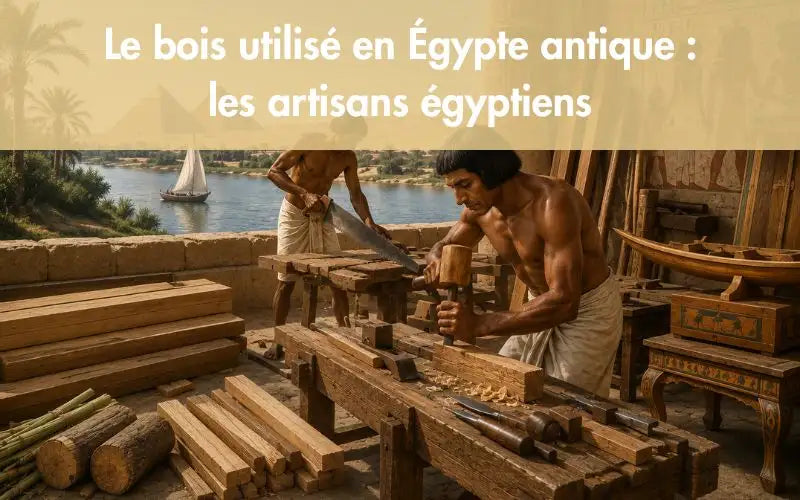
The wood used in ancient Egypt played an essential role in craftsmanship, daily life, and funerary practices. Despite the lack of large forests, Egyptian artisans utilized local species such as the sycamore fig, acacia, and tamarisk, while importing cedar and ebony.
They perfectly mastered the drying, cutting, assembly, and decoration of wood to create furniture, coffins, tools, statues, and watercraft.
Wood: a limited but essential resource
Ancient Egypt possessed trees in the Nile valley, gardens, and certain wetlands, but lacked large, straight trunks suitable for long beams. Local species often produced short, irregular, or knotted pieces, forcing artisans to assemble multiple elements to craft furniture, coffins, or boats.
This mastery of materials was accompanied by a deep attachment to protective symbols. The scarab ring is thus inspired by a major emblem of ancient Egypt, associated with rebirth, renewal, the solar cycle, and protection.
Light, durable, and relatively easy to work with, wood was also used to make doors, ceilings, tool handles, bows, chests, beds, chairs, and statues. Even scraps were carefully kept to be turned into pegs, repair pieces, or fuel.
This economy of material shows that wood was considered a precious resource. Every fragment could be reused and assigned a specific function in daily life, craftsmanship, or funerary practices.

Main local species worked by artisans
Among the woods used in ancient Egypt, the sycamore fig held an important place. Its light, fairly coarse wood was suitable for large pieces, statues, and especially coffins. It could be covered with linen, plaster, or gesso to hide its irregularities before painting and gilding.
Its frequent use did not mean that the objects were modest, as local wood could receive particularly elaborate religious decoration. This symbolic heritage is found today in our collection of Egyptian rings, inspired by the deities, amulets, and protective emblems of this civilization.
Acacia provided hard and durable wood, but its small trunks limited the length of pieces. It was used for furniture, tools, and certain parts of watercraft. Tamarisk, denser and coarser, also appears in numerous objects.
The jujube tree, or nabq, was suitable for small elements like pegs and tenons. The date palm was mostly used in construction and roofing, as its fibrous wood was less suited to fine joinery. By combining these species according to their qualities, artisans reserved the best pieces for visible or highly stressed parts.

Cedar, ebony, and other imported woods
The limitations of local resources led Egypt to import woods capable of providing longer, more uniform, or more prestigious planks. Lebanese cedar was particularly sought after. Durable and capable of taking a fine polish, it was suitable for high-ranking coffins, doors, quality furniture, and certain watercraft.
Its use came at a high cost: the British Museum notes that the material of a coffin influenced its price and reflected the status of its owner, with local woods being less expensive than imported cedar planks.
Ebony came from tropical African savannas. Almost black, very hard and heavy, it was primarily used for inlays, veneers, small decorative elements, and certain sculptures. Its color created a powerful contrast with ivory, bone, faience, or light woods. Other species, such as juniper, cypress, pine, ash, or elm, could be chosen for coffins, bows, arrows, or chariot parts.
These materials circulated through ancient commercial, diplomatic, or political networks. Their presence in Egyptian workshops thus reveals regular exchanges with the Levant, Anatolia, and regions located south of Egypt.

Egyptian joinery tools and techniques
Woodworking began with felling the tree, then cutting the trunk. Pieces could be split along the grain or sawn to obtain planks. Before use, artisans dried them by stacking them horizontally with spaces between them. This operation limited the warping and cracking caused by the moisture contained in freshly cut wood.
Joiners used axes, saws, adzes, chisels, and various drilling tools. The adze was used to flatten a surface or reduce the thickness of a piece, while chisels were used to cut the housings needed for joinery.
Elements were joined by mortise and tenon, pegs, dowels, bindings, and sometimes resinous glues. The chair of Hatnefer, dating from the beginning of the 18th Dynasty, illustrates this mastery: its parts are joined by mortise and tenon, held by pegs, and reinforced with glue.
Finishing required as much expertise as the structure itself. Veneers, ivory or ebony inlays, layers of gypsum, gesso, pigments, and gold leaf allowed irregular wood to be transformed into a luxurious object. Egyptian artisans therefore precisely mastered a complete chain, from raw material to final decoration.

Furniture and objects of daily life
Egyptian furniture shows that wood met functional, social, and aesthetic needs. Homes could contain stools, chairs, beds, chests, headrests, and small tables.
The simplest seats combined a wooden frame with a seat woven from plant fibers. Items intended for the elite featured carved legs shaped like animal paws, precious veneers, inlays, and protective symbols.
Artisans had to adapt the shape of the object to the limited dimensions of the material. Crossbars, legs, backrests, and reinforcements were made separately, then assembled with precision. Some curved pieces could be carved from naturally forked branches, which increased their strength while reducing waste. The repairs observed on several ancient pieces of furniture also show that these objects were maintained and used over long periods.
Wood was also used to produce cosmetic boxes, palettes, toys, musical instruments, tool handles, sickles, and writing tablets. Each object required a specific choice: hardwood to resist impact, lightweight wood for transport, plastered surfaces to receive an inscription, or precious wood to signify the owner's rank.
This search for a material that is at once durable, aesthetic, and symbolic is still found today in certain accessories, notably the wooden ring for men, appreciated for its natural nuances and unique character. The selection of the material thus contributed directly to the function and value of the object.

From coffins to boats: funerary and collective uses
In the funerary domain, wood was used to make coffins, statues, servant models, chests, headrests, and miniature boats. The sycamore fig was frequently chosen for ordinary coffins, while imported cedar could be reserved for high-ranking individuals.
Surfaces were often covered with gesso, then painted with texts, deities, and scenes intended to protect the deceased. A local wood could thus become the support for a complex religious program.
Shipbuilding required another form of expertise. Boats were essential for transporting people, harvests, animals, and stone blocks on the Nile. In the absence of local long beams, shipwrights assembled numerous planks and used bindings or fitted pieces. Imported woods facilitated the construction of larger ships or those intended for demanding journeys.
Material also played a role in architecture: doors, shutters, ceilings, scaffolding, formwork, and roofing elements. Even when these structures have disappeared, tomb depictions, scale models, and traces left on monuments allow us to reconstruct their importance. Woodworking therefore supported domestic life as much as religious practices, transport, and major state construction projects.

FAQ on wood used in ancient Egypt
Find answers to the most frequently asked questions about the wood used in ancient Egypt and the skill of Egyptian artisans. This FAQ presents the main local and imported species, their origin, their value, their different uses, as well as the assembly, decoration, and conservation techniques used to make furniture, coffins, statues, tools, and numerous everyday objects.
What was the most used wood in ancient Egypt?
The sycamore fig was one of the most used woods, particularly for making coffins, statues, and large pieces. Acacia and tamarisk were also common for furniture, tools, and small assembly elements.
Why was wood precious in ancient Egypt?
Wood was precious because Egypt possessed few large trees capable of providing long, regular planks. Artisans therefore used every piece with care and imported certain species for the most important projects.
Where did the cedar used by the Egyptians come from?
Cedar came mainly from the regions of the Levant, notably Lebanon. Its long, durable trunks that were easy to polish were sought after for prestigious furniture, coffins, doors, and watercraft.
How did artisans assemble furniture without modern screws?
Artisans used mortise and tenon, pegs, dowels, bindings, and natural glues. These techniques made it possible to create solid furniture and easily repair damaged parts.
How was wood decorated in ancient Egypt?
Wood could be carved, painted, gilded, veneered, or inlaid. Artisans notably used ivory, ebony, bone, faience, and colored pigments to create refined decorations.
Why have so many Egyptian wooden objects been preserved?
The very dry climate of the Egyptian desert regions greatly slowed the degradation of wood. Many pieces of furniture, coffins, statues, and tools have thus been preserved for several millennia.
Conclusion on the wood used in ancient Egypt
The wood used in ancient Egypt testifies to the ingenuity and mastery of Egyptian artisans. Despite the absence of large forests, they exploited local species such as the sycamore fig, acacia, and tamarisk, while importing cedar and ebony for the most prestigious works.
They mastered drying, cutting, assembly, gluing, inlaying, painting, and gilding. This precision was also reflected in the creation of symbolic objects, such as the Ankh ring, which is inspired by it today, associated with life, protection, and eternity in ancient Egypt. Artisans also knew how to repair and reuse various pieces in order to save this precious resource.
Present in furniture, coffins, tools, statues, and boats, wood occupied an essential place in Egyptian society. The preserved objects still reveal today all the creativity, precision, and expertise developed by these artisans.